


From debates around AI to cultural funding, we have selected some stories and projects that caught our attention from around the globe. AI is increasingly shaping conversations about the future. Anthropic CEO Dario Amodei recently called for developers to slow the release of frontier AI models, citing the potential for “serious” harm to humans. AI is moving fast. Perhaps too fast? As worries grow, how is it impacting the cultural world? AI and technology will now be a recurring theme, one we will continue to look at in future issues.
In this issue we feature Magdalena Moreno Mujica, Executive Director of IFACCA, the International Federation of Arts Councils and Culture Agencies, who works at the intersection of culture, policy and international cooperation. For her, building bridges means making room for different perspectives to enter, be heard and remain part of the conversation.
Our reading recommendation takes us further into the conversation around AI with Scary Smart by Mo Gawdat. The former Google executive explores how we might collectively shape the relationship between humans and artificial intelligence and, ultimately, the future we want to build.
As we bring the first year of Echoes from Afar to a close, we hope you enjoy this final issue of the year and would love to hear your thoughts in the comments. We’ll be back in January with more stories and perspectives from across the globe.
AI & Technology
CANADA, FRANCE & HAITI Writer accused of using AI
The French literary prize Prix Goncourt removed Thélyson Orélien’s 2026 novel, C’était ça ou mourir (“It was that or die”) from its 16-book longlist. The judges said the book was “in all likelihood largely the product of artificial intelligence”. The Haitian-Canadian author denied the allegation. The novel follows a man who undertakes a perilous journey across the Americas to escape gang violence in Haiti. Orélien previously said his own experience of leaving Haiti following the 2010 earthquake and stories of other migrants he met in Montreal helped shape the novel. The case renewed debates about how the industry should be using AI and its detection tools. (Source: CBC News)
DOMINICAN REPUBLICWhat does AI actually mean for museums?
In September, museum and heritage professionals from 18 countries gathered in Santo Domingo for the 12th Ibero-American Museum Meeting, “Shared Heritage, Common Future”. The meeting explored how museums could respond to social, technological and environmental change with discussions highlighting the growing role of AI and priorities for regional cooperation across Central America and the Caribbean. (Source: Ibermuseos)
SAUDI ARABIASaudi Government launched AI incentives for cultural projects
Saudi Arabia launched a new funding initiative offering non-repayable grants of up to SR500,000 per project to help cultural enterprises adopt and develop artificial intelligence technologies. The initiative is the first track under the Cultural Development Fund’s Numou Incentives, designed to support cultural projects in priority areas aligned with national objectives. Saudi Arabia has officially designated 2026 as the “Year of Artificial Intelligence”. (Source: Saudi Gazette)
This development raises broader questions about the likely widening of the global AI/digital divide between those in the AI race and those left behind, and what that means for the future of the production, reception and consumption of art and culture.
UKMuseums explore AI for innovation and revenue
Museums are increasingly exploring AI to engage visitors and generate new revenue, while confronting questions about data ownership and ethics. Major institutions like the Natural History Museum, Imperial War Museum and V&A are involved in a government-backed pilot to license cultural datasets to AI developers. The Natural History Museum, for example, has licensed biodiversity health data to asset management group BlackRock to inform nature-aware investment decisions. (Source: Financial Times)
Funding & Creativity
COLOMBIA Artists and cultural workers push back against Colombia’s arts funding cuts
Hundreds of artists, students and cultural workers took to the streets in Bogotá last month to protest a proposed 30% reduction in Colombia’s cultural budget for 2027, and the proposed suspension of national arts awards. This highlighted concerns about the vulnerability of public cultural funding. (Source: ArtForum)
GHANA“New Africa Cultural Initiative” hopes to build an arts infrastructure in Africa
Richmond Orlando Mensah, founder of Manju Journal, launched the “New Africa Cultural Initiative” (NACI), a non-profit focused on artistic development and exchange through research, cross-disciplinary collaboration and strategic programming. Beginning in Accra, its first-year programmes will expand to Lagos, Dakar and Abidjan, with a focus on craftsmanship and locally rooted creative practices. The initiative asks how the continent’s creative sector can move towards long-term sustainability and local agency. One of its longer-term ambitions is to build a fund and move away from a Westernised funding structure. (Source: ARTnews)
POLAND Poland’s art scene: growth amid funding pressures
Warsaw Gallery Weekend last month showed a Polish art market on the rise but does growth come at the expense of experimentation, as galleries increasingly favour safer, more familiar and commercially viable work?
The article also pointed out Poland’s heavily state-dependent cultural funding system, so private giving is not strongly incentivised and private support remains rare. Ahead of next year’s national elections, a coalition of business and cultural organisations is lobbying the centrist government to introduce tax incentives for cultural sponsorship. This comes as defence spending puts further pressure on public funding for culture. (Source: Ocula)
USAuction house and artists pilot new resale royalty model in New York
Ahead of its November sales in New York, Bonhams teamed up with the musician-making and art-collecting power couple Kasseem “Swizz Beatz” Dean and Alicia Keys to explore ways for artists to benefit financially when their works increase in value after their initial sale. The voluntary programme will allow consignors to contribute a portion of the hammer price to artists, which Bonhams will match. While resale royalties are common in other art forms and in more than 90 countries for visual artists, efforts to establish such rights in the US have largely stalled. (Source: The Art Newspaper)
Cultural Policy & Cultural Diplomacy
FRANCE & UK Bayeux Tapestry as a tool for diplomacy
The loan of the Bayeux Tapestry from France to the UK is more than an exchange of cultural objects. It demonstrates how museums, collections and shared histories can create opportunities for dialogue between countries, even when political relationships have been complicated. The Tapestry itself, which tells the story of the events leading up to the Norman invasion of England, is a reminder that relations between the two countries have ebbed and flowed for centuries. (Source: Observer)
NIGERIACreative industries positioned as part of Nigeria's $1 trillion economic ambition
Nigeria is positioning its creative industries as part of its wider economic strategy. The National Institute for Policy and Strategic Studies estimated that the orange economy could contribute up to $450 billion to the economy if properly developed, linking cultural policy to the country’s ambition of reaching a $1 trillion economy by 2030. (Source: Daily Trust)
UAELocally grounded and globally relevant lens on Asia
Set to open in December, the Asia Institute at Global Studies University in Sharjah is developing as an interdisciplinary hub for the study, research and documentation of Asia and its global connections, with a focus spanning the Indian Ocean, Arabian Gulf and beyond. It will hold an inaugural conference, “Global Asia: The State of Asian Studies in the 21st Century”. (Source: The Asia Institute - GSU)
US New York increases support for culture
New York mayor Zohran Mamdani approved a record $323.8 million budget for the Department of Cultural Affairs, including establishing a Cultural Stability Fund providing $10 million annually through 2029 to support eligible cultural organisations facing unexpected or emergency circumstances.
As cities face rising costs and shrinking cultural spaces, funding alone is not enough. As the article noted, cities also need long-term policies that enable experimentation and make culture part of urban development. (Source: Observer)
Cultural Hotspots to Watch
EGYPTCairo’s creative scene gathers momentum
Cairo Design Week returns for its fourth edition in November, continuing to position the Egyptian capital as a meeting point for design, creativity and cultural exchange. Cairo Design Week founder Hisham Mahdy said since its launch it has grown from a platform to showcase Egyptian design into a meeting point for regional and international creatives, institutions and brands. (Source: Arab News)
MALAYSIA Muara Arts puts Southeast Asian art in focus
Housed in restored Art Deco shophouses at Medan Pasar, Muara Arts is set to become Malaysia’s first not-for-profit gallery dedicated to Southeast Asian art. Founded by Shanthi Kandiah and Brahmal Vasudevan under the Creador Foundation, it aims to connect artists across the region and foster artistic exchange across Southeast Asia and beyond. Its inaugural exhibition opening in November, A–Z of Southeast Asian Art: A Critical Dictionary, brings together more than 40 artists across diverse media. (Source: The Peak)
Alongside developments in Bangkok, Singapore and Jakarta, Muara Arts adds to the momentum around regional artistic exchange.
MEXICOYucatán Biennale: when language becomes territory
Set to take place in Mérida, Mexico, from November 2026 through February 2027, the new Yucatán Biennale will bring together about 75 artists from Mexico and around the world, exploring language, from oral traditions and indigenous voices to identity, memory and cultural expression. Curated by Abraham Cruzvillegas, the citywide festival aims to boost the cultural scene and elevate the city's cultural profile on a global scale. (Source: Yucatán Today)
Transmission, Heritage & Crafts
LEBANONPreserving Tarq, an endangered embroidery tradition
Luminous Threads, part of Creative Dialogues’ Beirut Edition 2026, celebrates Tarq, a rare metal-wire embroidery tradition rooted in Baalbek and preserved by generations of women. Crafted with fine, flat metal wire, Tarq is deeply rooted and extraordinarily rich, yet remains largely undocumented and today, only a few artisans continue to practise it. A joint effort by Creative Dialogues, Majal Design School and Sage Archives aims to safeguard this heritage through documentation, training and economic support. (Source: Creative Dialogues)
*Related metal-wire embroidery traditions exist elsewhere in the region, including Bahrain’s Al Naqdah and similar practices in Egypt, raising questions about their shared origins and movement across borders.
NETHERLANDS Museum Vonk builds on the past with bio-based materials
Studio Marco Vermeulen designed Museum Vonk, which merges the existing open-air Prehistoric Village museum and Eindhoven Museum. The design prioritised bio-based materials in homage to Prehistoric Village, which features artisanal buildings made from wood, clay and reed, but using a more high-tech approach. This led them to use a reclaimed timber structure salvaged from Biobasecamp, a pavilion created by the studio for Dutch Design Week 2019 that could be easily reused. (Source: Dezeen)
Dutch Design Week, held annually in Eindhoven, returns from 17–25 October 2026.
PALESTINE Palestine Museum Digital Archive: an archive against erasure
Since 2018, the Palestinian Museum has been building an “unlootable archive” to preserve Palestinian history beyond any single building. It now holds more than 500,000 photographs, identity papers, diaries, maps, films and letters, many collected from Palestinian families, with support from diaspora donors and international partners. It required back ups to withstand cyberattacks and physical destruction. For Director Amer Shomali, the archive helps Palestinians reclaim ownership of their history. “Having the digital archive is a way of protecting our memory,” he said. The project has been exhibited more than 260 times, from Japan to San Francisco, and translated into five languages. (Source: WIRED)
UKRAINEProtecting heritage in wartime
Ukraine developed a handbook for its troops on protecting cultural property, highlighting the role of heritage protection during armed conflict. The guidelines aim to make international laws readily accessible to soldiers on the ground, and reflect Ukraine’s experience in the war against Russia. The army’s Cultural Property Protection unit marked 58 cultural sites with 184 Blue Shield emblems and helped evacuate 44 medieval Polovtsian statues for safekeeping. (Source: The Art Newspaper)
Togetherness
ARGENTINA, BRAZIL, COLOMBIA, ECUADOR, PERU, PORTUGAL, SPAIN & URUGUAYLibraries rethink reading in the age of AI
Libraries from nine Ibero-American capitals gathered in São Paulo under UCCI, UNESCO and CERLALC to kick off “MILes de lectores”. The initiative asks what reading means in an age of abundant machine-generated text, emphasising skills such as interpreting, constructing meaning, comparing sources and developing critical thinking. It also rethinks the library’s role as a community space. (Source: UNESCO)
Elsewhere, Singapore is offering incentives for people to put down their phones and read books. (Source: Gadget Review)
AFRICA, UK & USCan a photographic portrait inspire political imagination?
MoMA’s Ideas of Africa: Portraiture and Political Imagination explored how photographers and their subjects helped shape ideas of Pan-African identity and solidarity in the mid-20th century. (Source: Africa Art News)
The exhibition forms part of a wider revival of interest in Pan-African cultural histories, echoed by the Barbican’s Project a Black Planet, which traces the influence of Pan-Africanism on art and culture from the 1920s to today.
CHINA & THAILANDA migration tale shot in a southern Chinese dialect finds global audience
“Dear You” was shot mostly in Teochew, a dialect spoken in Guangdong’s Shantou region. Set among the Teochew immigrant community in Bangkok, it tells the story of people who left China in search of work to support their families. Made on a low budget with mostly unknown actors, the film has succeeded in making this little-discussed history of Chinese migration to Southeast Asia visible to a wider audience.
The Chinese government began promoting the film as it became a hit and prepared for its international release. The Chinese consul in Sydney said at a June screening of the film that it reflected the Chinese nation’s virtues. (Source: AP News)
CHINA & USWhen private collections foster cross-cultural dialogues
Form, Shadow, Motion: Selections from the Burger Collection brings together artists from Asia, Europe, the Middle East and the United States, exploring themes including historical time, memory, erasure, diasporic displacement and exchange. Opening at The Drawing Center in New York before travelling to Asia Society Hong Kong in 2027, the exhibition from the BURGER Collection offers an example of how private collections can create conversations across regions and cultures. As collector Monique Burger put it, her approach to collecting and to working with institutions is very personal and begins with “a conversation, a dinner, a studio visit”. (Source: ArtAsiaPacific)
KOREAThe self-help Gwangju Biennale 2026 You Must Change Your Life
Founded in 1994 against the backdrop of Gwangju’s history of democratic struggle, the 16th edition of Gwangju Biennale takes its title from the final line of Rainer Maria Rilke’s 1908 poem Archaic Torso of Apollo. For artistic director Ho Tzu Nyen and curators Park Gahee and Brian Kuan Wood, the poem transforms the reader into the viewer of an imaginary ancient Greek sculpture, to imagine and complete what is received as fragments.
They were drawn to the title’s combination of force and openness, shaping how they approached the exhibition. Their interpretation of “self-help” centres on empowerment and the belief that transformation does not require breaking with the past. (Source: ArtReview)
Check out another review from ArtAsiaPacific: A Low Hum: The 16th Gwangju Biennale.
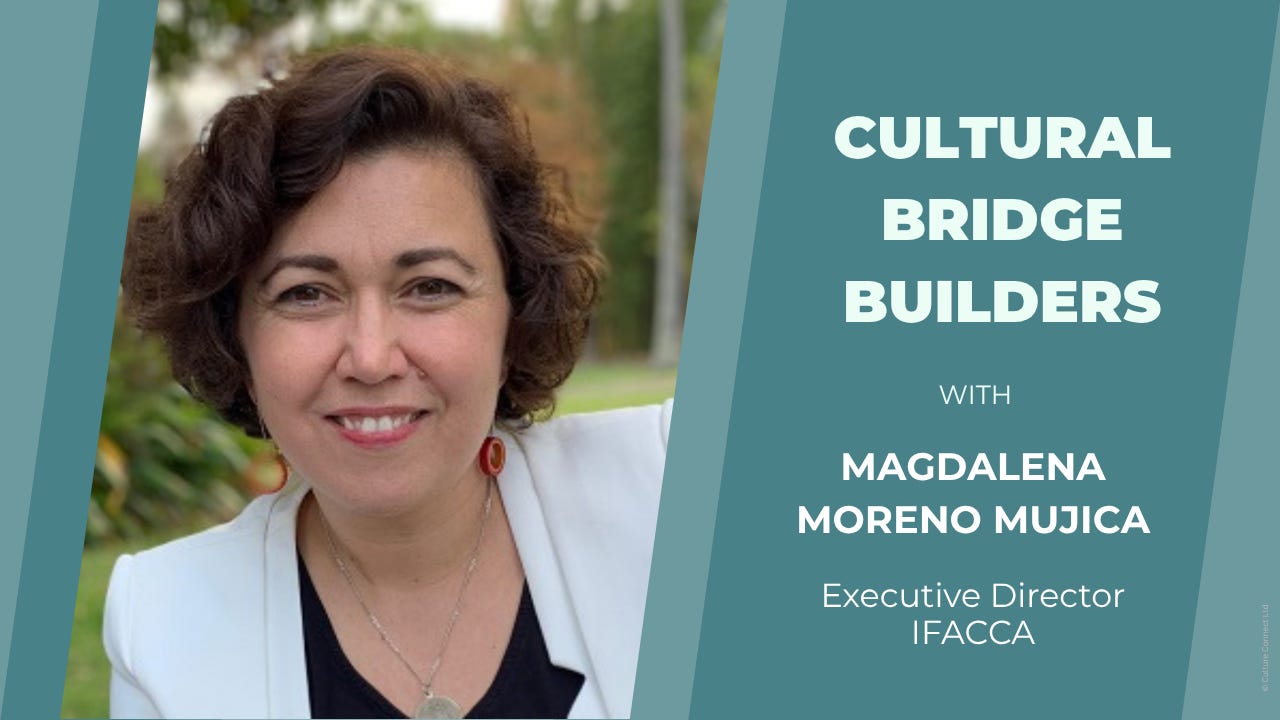
THE ART OF MAKING THE ROOM BIGGER: A CONVERSATION WITH MAGDALENA MORENO MUJICA
Portrait written by Anaïs Aguerre, Founder and Director of Culture Connect
I have known Magdalena for some time now and have always been struck by the way she approaches people and ideas: with curiosity, openness and a genuine desire to understand what lies behind a different perspective. There is a warmth to the way she works but also a quiet determination to create space for conversations that might not otherwise happen.
As Executive Director of IFACCA, the International Federation of Arts Councils and Culture Agencies, she works at the intersection of culture, policy and international cooperation. But the thread running through her career is more personal: a lifelong instinct to enter unfamiliar rooms, understand the languages being spoken and make those rooms bigger so more perspectives can enter and matter.
Learning to enter the room
“I grew up travelling a lot,” Magdalena tells me as we start our conversation.
Her father was a Chilean diplomat, so Australia, the Philippines, Bolivia and Peru became part of her childhood landscape. When she arrived in Canberra to start primary school, she did not speak English. She remembers it vividly: “If I ever thought what the Tower of Babel would look like, it was people talking to me like that and I didn’t understand anything.”
She did not retreat. She “created [her] own little world and started to speak the language”.
There is something in this early experience that seems to echo throughout her life: the instinct to move towards the unfamiliar, to listen, to adapt and to find a way into the conversation.
Magdalena describes herself as “100% Chilean”, while also acknowledging the profound influence Australia has had on her life. As a child, she absorbed the places around her, picking up local accents and ways of speaking. “I was probably the most comfortable and fully embraced any culture we went into wholeheartedly,” she recalls, remembering how she and her siblings settled into each new city.
Language was the key. For her, it was never simply about communication. It was a way of entering a place. And perhaps, over time, this became something larger: an ability to move between worlds, to understand different perspectives and to notice who was – and who was not – able to take part in the conversation.
From the studio to the system
Her professional path was equally non-linear.
“My whole career has been a series of circumstances. Nothing has been linear.”
She began as an artist and printmaker, moving into museums and international cultural work before finding her way into cultural policy. Along the way, questions of representation became increasingly important: Who speaks for whom? Who has the authority to tell someone else’s story? And whose perspective is missing from the conversation?
At one point, she experimented with using a male Anglo-Saxon pseudonym for her art work and noticed how differently it was received. The experience sharpened a question that would follow her: who has the power to represent whom?
Those questions became particularly tangible through her work with museums and cultural institutions, where relatively small, predominantly Western groups could shape conversations with global implications. She began asking what it meant to engage with “living culture”. She realised she wanted to influence not only the outcomes of those conversations but how they happened in the first place.
“I need to influence how these conversations happen,” she remembers thinking.
The art of making the room bigger
At a certain point, the visual arts were no longer enough.
“Visual practice is too limiting for me,” she says. “I need to... start thinking of different ways in which I can have an impact.”
Moving into cultural policy was not a departure from art, but an expansion of its vocabulary. It gave her access to different tools for shaping conversations, connecting people and changing systems. For Magdalena, networks are not simply about knowing people. They are about creating the possibility for ideas, experiences and perspectives to move between them.
That is where her understanding of bridge-building becomes particularly interesting. Building bridges does not mean smoothing over differences or bringing everyone to the same conclusion. It means making enough room for different perspectives to enter, be heard and remain part of the conversation.
“Building bridges has always been my calling, just broadly,” she says.
Her work in international cultural cooperation reflects that philosophy. She is wary of the traditional dynamic in which one side arrives as expert, funder or giver and the other becomes recipient. Real exchange, for her, has to be reciprocal: everyone brings something and everyone has something to learn. Enabling a voice is not the same as speaking for it.
Purpose matters
That sense of intention also shapes where she chooses to work.
“I am very passionate about what I do,” she says, “but that’s also because I’m very intentional where I work.”
For Magdalena, the starting point is always the question behind the institution: why does it exist, and what problem is it trying to solve?
It is perhaps why her career has never needed to follow a straight line. She follows the question rather than the category, moving between art, museums, policy and international networks whenever a new set of tools is needed.
A systems thinker with an artist’s eye
There is something distinctly artistic in the way she approaches systems.
An artist notices what is absent, what feels unresolved, what could be different. A systems thinker asks what needs to change for that possibility to become real. The artist notices the empty chair. The policy thinker asks how to make sure someone can take it.
At IFACCA, this translates into creating opportunities for countries, communities and perspectives that are championing arts and culture, but operating in heavily saturated and contested environments to connect, share experiences and strengthen their own voices. The aim is not to make everyone speak with one voice. It is to make the room large enough for diverse voices to be heard.
Finding the language between us
In many ways, Magdalena’s story comes back to where it began.
A child arrives in Canberra unable to understand the language around her and learns to enter a new world through language. An artist becomes fascinated by representation and who gets to speak. Then visual practice becomes too narrow, and she searches for a broader vocabulary. Today, she works through international networks and cultural policy, creating opportunities for different perspectives to enter, meet and matter.
The bridge, in her world, is not simply a structure connecting two fixed points. It is a place of encounter. It is somewhere where people can arrive with their own histories, identities and ways of seeing, and still find enough common ground to begin something together.
Perhaps that is the real art of building bridges.
Not making difference disappear.
Not speaking for others.
Not standing safely on one side and explaining the other.
But making the room bigger.
Making the crossing possible.
Being willing to step onto the bridge, listen, stay curious and meet somewhere in the middle.
Because sometimes the most important thing a bridge can do is not bring us to the other side. It is to give us a place where we can meet.
Our quick-fire round
1. When did ‘international’ first enter your life? Did you know then it would stick?
I was four years old the first time I got on a plane, and I thought, “This is for me.” I grew up travelling a lot. My father was a diplomat from Chile, so when I was young, we travelled a lot. I started to get a sense of the world at a very young age.
2. What’s the secret to a great international collaboration, and what do people gain from it?
The secret is to start from an equal base. Everybody has something to share. It cannot be unidirectional. It doesn’t matter whether you’re a funder or a beneficiary. I don’t even like using the term “beneficiary”, because I think beneficiaries are from both sides.
Make sure that the integrity of what you believe in is in no way being placed at risk, and that, if anything, it is being amplified by this opportunity to collaborate. Then be very open to the fact that you may be challenged. But that’s part of the journey, and that can be a wonderful and enriching experience that can actually open up new possibilities.
3. Which projects best capture your international work? What’s next?
I would say that my favourite project is all the little occurrences that happen in between. So it’s not necessarily the output. It’s much more the nuance of the journey, of the learning, of the exchanges, of the mistakes along the way, and of the problem-solving together. That is the most enriching experience of it all.
And also when you can imagine or abstractly think that something will work, but then see it materialise when there is a group of people, or two people, that you know have got so much to contribute, but they haven’t had the opportunity to meet each other. You can see that their sparks are - you know, their eyes are opening up - and you can see, okay, it happened.
It’s that magic that happens when people see themselves reflected, but at the same time recognise that you’re different. There’s something quite wonderful about that, and that can happen on a stage at a world summit.
We’re currently doing a project called the “Globus Fellowship”, where we’re accompanying about 12 different future leaders from the Global South to engage with and look at the issues within their own context and learn from each other. We took them to Vietnam, where they had an opportunity to learn and engage. It’s just that you start to open up, and you can actually see those sparks happen.
What I’m really excited about is a new project that we’re working on, which is going to be looking at investing in culture beyond the economic framing, looking at what is happening around the world, the tensions between budgets reducing, the cost of living and everything, and where does culture sit? What are the new models and ways in which we really need to think outside of the box?
And I’m very excited about our new strategy. For next year, I’m ready to look at how we tackle the major AI and human question. I think we’ve reached a moment when we’re starting to finally recognise what is at stake that, even though some say, “Oh, it’s now too late,” it’s not too late to really make sure that we have control over our cultural and creative practices, our imagination and we protect and enable it to thrive. I think the role of arts and culture is really going to be critical.
4. How do you see international collaboration evolving in today’s complex world?
I see it as essential. It’s not linear, and we need to find ways to create spaces for healthy debate. It’s generally quite difficult because, obviously, it’s most meaningful when done offline.
Our in-person meetings are really important, but at the same time, I know we’ve got the cost-of-living situation and the environmental impact to consider. But I think we can’t solve these problems independently. We need our neighbours, our colleagues, our communities around the world, to help us do this together.
5. Is there a work of art, song, performance or film that captures the essence of cultural exchange for you?
This might be a little bit out of the box, but rather than the artwork itself, it’s the audience. It’s the people attending an exhibition, the people sitting in a performance hall or at a festival.
To me, it’s about (and it doesn’t necessarily mean that it’s bums on seats, meaning that it’s full of people) seeing people connect with the work of art, with the music.
Of course, I have my favourites. Angélique Kidjo is one of my favourite artists. There are lots of people that I like, and lots of books that I love. But because you ask about cultural exchange, it is that reflective moment of engagement with an artwork that, to me, is really precious and best demonstrates what that artwork is.
I was also really impacted by Christian Boltanski’s work at the Palais de Tokyo. And more recently, Tony Albert’s exhibition at the Museum of Contemporary Art (MCA), This Is Not a Souvenir. He’s a very important contemporary Aboriginal artist. Incredible practice.
6. One book you’d press into someone’s hands to spark their curiosity about the world?
A very funny book that I love is Umberto Eco’s How to Travel with a Salmon & Other Stories. It’s silly. It’s kind of silly, but I love that.
But in terms of the imagination, I mean, you can’t get past One Hundred Years of Solitude by Gabriel García Márquez.
Our Reading Recommendation
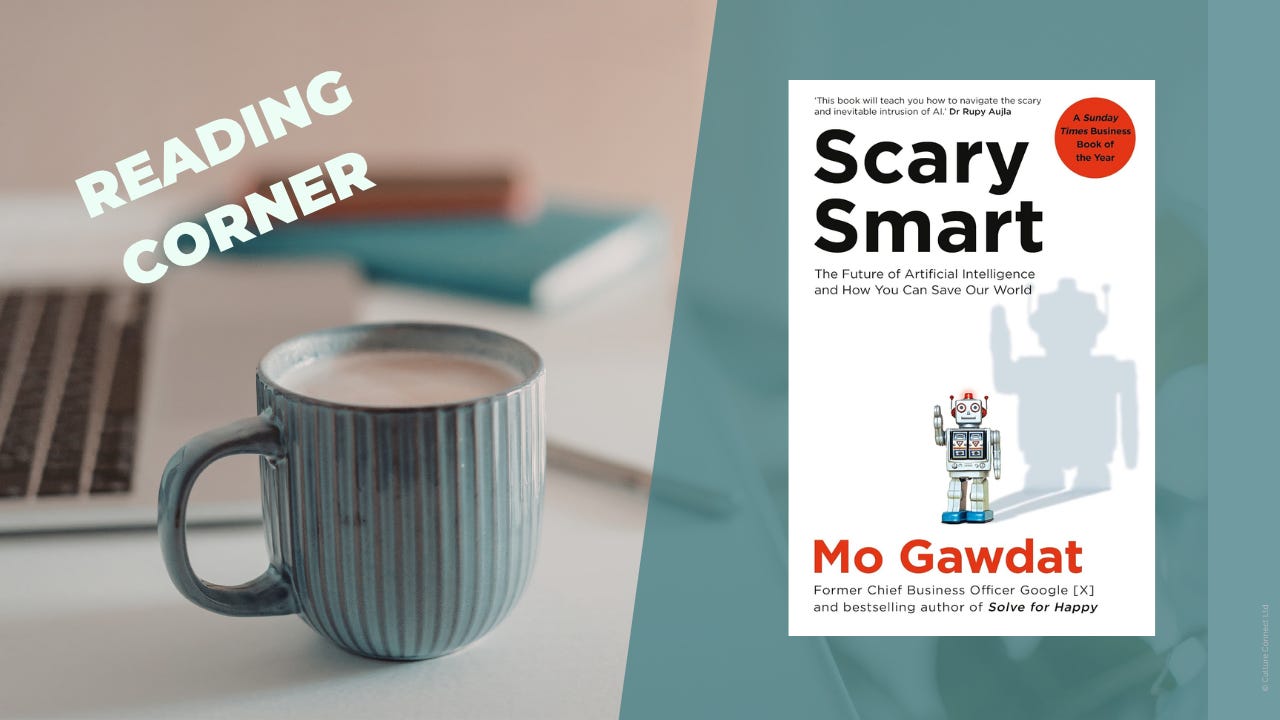
As Meta has just announced Muse Charm, a new pocket-sized device designed to keep its personal AI agent, Muse, with us throughout the day, marking another step towards AI overtaking more and more aspects of our daily lives and human interactions, we thought it would be helpful to take a step back and revisit a book that asks some fundamental questions about where AI is taking us and what it means to be human.
Published in 2021, Scary Smart: The Future of Artificial Intelligence and How You Can Save Our World was written by Mo Gawdat, former Chief Business Officer of Google X and a long-time technology executive. His perspective is both technological and deeply human: if AI is going to become increasingly intelligent and embedded in our everyday lives, what values will we teach it?
Gawdat’s central argument is that the future of AI is not simply about how intelligent machines become, but about what they learn from us. AI reflects the systems, behaviours and values we expose it to, making empathy, compassion, cooperation and human values increasingly practical questions, rather than simply philosophical ones.
Five years on, some of the questions he raised feel increasingly close. As AI moves into our conversations, relationships and daily routines, Scary Smart offers a useful moment to pause and consider not just what these technologies can do, but what we want them to become.
We had the pleasure of inviting Mo to give a keynote at Culture Summit Abu Dhabi 2025, which we curated around the theme ‘Culture for Humanity and Beyond’. His talk is a particularly good companion to the book and one we recommend revisiting alongside it.
Perhaps the most interesting question to take away from both is: what can this new technological frontier teach us about who we are, what it means to be human, and how we want to live together?